Pulp – the sustainable, affordable wipe solution
Pulp‑based nonwovens deliver a compelling balance of full wipes functionality, cost efficiency, global availability, and environmental performance. Together with partner Voith, Trützschler Nonwovens provides proven technologies that transform softwood pulp and dispersible staple fibers (e.g., viscose, lyocell, polyester) into high‑quality nonwovens for flushable, baby, and body wipes—at industrial scale.
Trützschler Nonwovens and partner Voith offer various efficient machinery and production line concepts.
Your benefits from pulp technologies:
Lower fiber cost with softwood NBSK pulp vs. 100% PET, viscose, or lyocell fibers for classic wipes
Consistent global supply—NBSK pulp is a paper industry standard
Fully biodegradable wipes from 100% cellulosic fibers, i.e. a combination of pulp, viscose and lyocell
Proven at scale—up to 20,000 t/year
Flushability leadership—WLS is the basis for genuine flushable wipes that meet tough EDANA and IWFSG criteria
Mature and field‑proven—pulp‑based lines are running for almost a decade
Pulp technology at a glance
Wet‑laying is the forming technology of choice in the paper industry. The process creates uniform, high‑quality pulp sheets at high speeds. It starts with dispersing pulp fibers in water, depositing them onto a moving wire to form a highly even sheet with exceptional thickness uniformity and formation quality.
Early on Voith adapted this proven technology to produce specialty nonwovens. By combining Voith’s sheet formation technology with our expertise in hydroentangling and drying, we jointly developed a new type of pulp-based, strong, yet soft spunlaced nonwovens.
The two main technologies are
- Carded/Pulp nonwovens (CP)
- Wet-Laid/Spunlaced nonwovens (WLS)
Wet-Laying/Spunlacing – Engineered for productivity
In WLS processes, wet-laying is the only web forming technology. The raw material blend consists of softwood NBSK pulp combined with short-cut viscose, lyocell or PET fibers between 8 and 12 mm.
The slender NBSK fibers enable excellent entanglement thus minimizing pulp loss during hydroentangling.
A WLS production line for flushable or full-strength wipes

Discover:
- Voith’s HydroFormer, in use in over 70 wet-laid lines
- Our specialized CP/WLS Aquajet that ensures reliable fiber pulp fiber integration into the nonwoven
- Our high-performance, modular MPD dryer for energy- and space-efficient drying

Line characteristics
Web weights: 30 to100 gsm
Fibers: pulp, short-cut viscose, lyocell, PET and other dispersible fibers
Output: more than 20.000 tons per year
(depending on fiber type, web weight and working width)
Typical end products: flushable wipes and high-quality wet wipes for baby or body care
Carded/Pulp – Engineered for flexibility
CP processes create a composite, dual‑layer nonwoven that is made of a 100% pulp wet‑laid sheet and a carded web of staple fibers with standard lengths of 38–40 mm.
This design with both a sheet forming system and a nonwoven card offers exceptional process flexibility. Depending on production needs, operators can run only the wet‑laid section (essentially producing WLS‑type substrates), only the carding section to create traditional spunlaced nonwovens for wipes or combine both layers into a two‑layer composite.
As a result, a CP installation can deliver economical wipe substrates as well as premium qualities with tailored softness, strength, and bulk.
A flexible CP nonwoven line
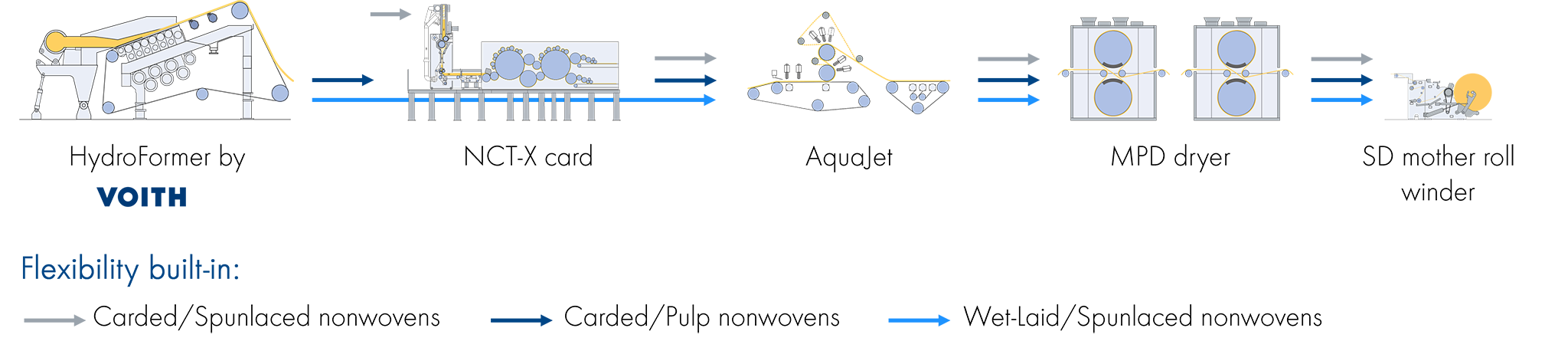
Discover:
- Voith’s HydroFormer, in use in over 70 wet-laid lines
- Our X-series of cards
- Our specialized CP/WLS Aquajet that ensures reliable fiber pulp fiber integration into the nonwoven
- Our high-performance, modular MPD dryer for energy- and space-efficient drying
Line characteristics
Web weights: 30 to100 gsm
Fibers: wood and non-wood pulp, standard size viscose-, lyocell, PET and other fiberss
Output: more than 20.000 tons per year
(depending on fiber type, web weight and working width)
Typical end products: top quality wet wipes for baby and body care

Why is pulp a smart choice for single-use wipes?

From renewable resources
Wood or non-wood based pulp plus 100% viscose or lyocell cellulosic fibers

Biodegradable
Nonwovens typically fully biodegrade within 10–12 weeks in soil environments – leaving no microplastics behind

Small CO2 footprint
Favorable CO₂ balance for pulp due to biogenic carbon uptake

Future-fit
Sustainable single‑use products are becoming a regulatory imperative
Global markets are tightening rules on biodegradability, microplastics, and environmental safety—directly affecting baby wipes, body wipes, and especially flushable products. Choosing pulp‑based WLS and CP substrates enables producers to meet these stricter standards, and future‑proof their portfolios.
An even more sustainable raw material is bamboo pulp. Bamboo is fast growing and plantation suitable. When harvested after 3 years, the plant has absorbed more CO2 than a softwood tree within decades of growing. Bamboo pulp performs comparably to NBSK pulp in our trials.
